
Poetry In Stone
the gift of Brookgreen Gardens

My hand reached up to find hers, back then. I was five at most, and on that Sunday afternoon in early April, walking under the drifting shadows of Spanish moss-laden oaks, she began my education. She didn’t preach hellfire and damnation, and she didn’t instruct me on dogma. Instead, she walked me past the azaleas as they spoke lush pink and purple liturgies, to stand before a granite slab etched with verse. She read it out loud, but almost a whisper.
“Men made me dread to meet God, —
but I found it sweet, —
I who had disobeyed
the laws men said He made.
Yet from Him was no ‘You!
You wretch, for mercy sue!
You wicked sinner!’ Rather
just like a gentle father,
‘Son, how your garden grows!
I love that yellow rose.
And that narcissus seems
come from a land of dreams.
For the fine work you’ve done,
I’m proud of you, dear son.’”
Those words rested like felt on me, soft and warm, brushing aside the pronouncements of preachers and demanding deacons. In that moment, I folded its truth carefully and placed it into the pocket of my memory.
The poem is The Meeting, by Archibald Rutledge, the first Poet Laureate of South Carolina. The place is Brookgreen Gardens. And she — she is my mother.
I was a small, sensitive child, prone to asthma and deep feelings. The world as it was lived by men then, was hard for me, and I think my mother knew I needed something more. She didn’t seek to protect me, but to introduce me to something that might better hold my heart. Poetry. Artistic beauty. And Brookgreen was, and is, the perfect Sunday school room.
Brookgreen Gardens has a history as rich and dark as the South itself. Originally the fertile land of the indigenous Waccamaw people, resting between the fresh waters of the Waccamaw River and the open sea of the Atlantic, this land was wild and abundant. When the Europeans came, its access to fresh water and rich soil spoke rice plantation to them, and soon the hands of enslaved people worked the land under its master, William Allston. The year was 1779. Still, oppression has always provided ground for creative growth, and even then, that was true. Washington Allston was born on that land and became one of the most celebrated American artists of his era. In time, the land was purchased by Anna Hyatt and Archer Huntington. Anna was an award-winning sculptor at a time when few women were successful artists. She created the first public monument by a woman in New York City, Joan of Arc. She believed sculpture was best experienced in nature, not a museum. That conviction is Brookgreen.
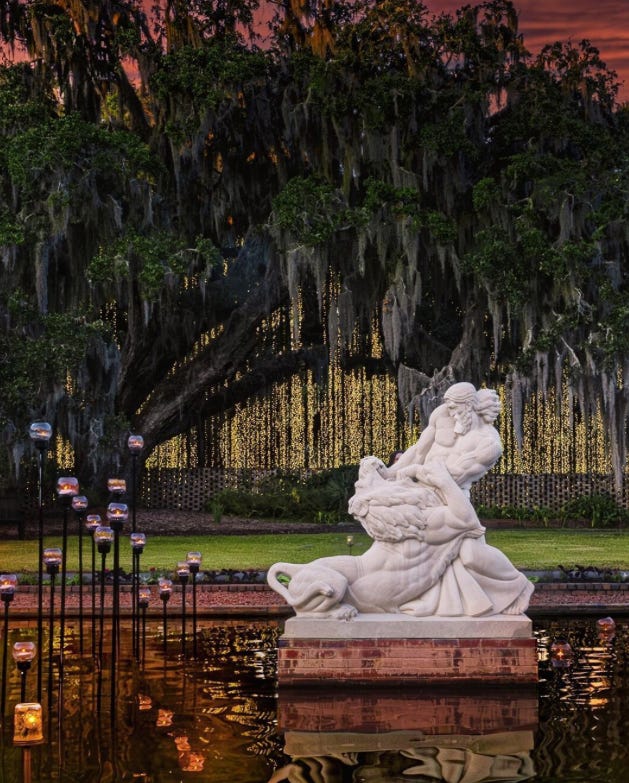
This richness is what my mother walked me into those Sundays. After sitting in the pews of First Baptist Church, we would picnic at Brookgreen and then walk. Sculptures of American statuary — the largest outdoor collection in North America, then and now — stand amid rows of azaleas, ancient oaks, and brick-bordered fountains. Her quiet words during our walks there did to me what the chisel did to stone.
My mother is now 93 and bound to a wheelchair. When I stand beside her, it is her hand that reaches up to find mine. She is too frail to visit Brookgreen anymore, but Brookgreen visits her every time she speaks of it.
At her request, when the shadows stretch long and poetry reaches for her one last time, I will stand in a pulpit. I will unfold that memory, and my words will be Rutledge’s words — the ones she first whispered to me beside a granite slab, amid fountains and towering statues, on a Sunday afternoon in early April, when my hand reached up to find hers.
Don’t want to make the commitment? Drop a one-time gift here.
This is really touching.
My grandma used to lend me books when I was little.
She used to wait until I read them and ask what were my thoughts on them. Then with my super vivid 8/9 year old inagination I used to tell her all about what I like and what I didn't.
And she just listened with a smile, sharing her thoughts from time to time.
It's beautiful how literature can connect us to our loved ones.
This hit a point in my heart. When my mother died, I had no idea of her last wishes, and was too far away, she died suddenly without any alarming signals, I had to travel for the funeral. After some weeks, already back home... I was opening some of her folders I brought with me, and in the middle of casual bills and notes I found a page where she handwrote some of the things she wanted when of her departure... no formal services, just someone to sing a few songs she pointed.
More or less a half year later, I had to go there to solve some issues; and when I found a free space I went to her resting place, took some flowers and sang these songs for her, while sitting on the floor by her grave. Was half year later, but was done.